
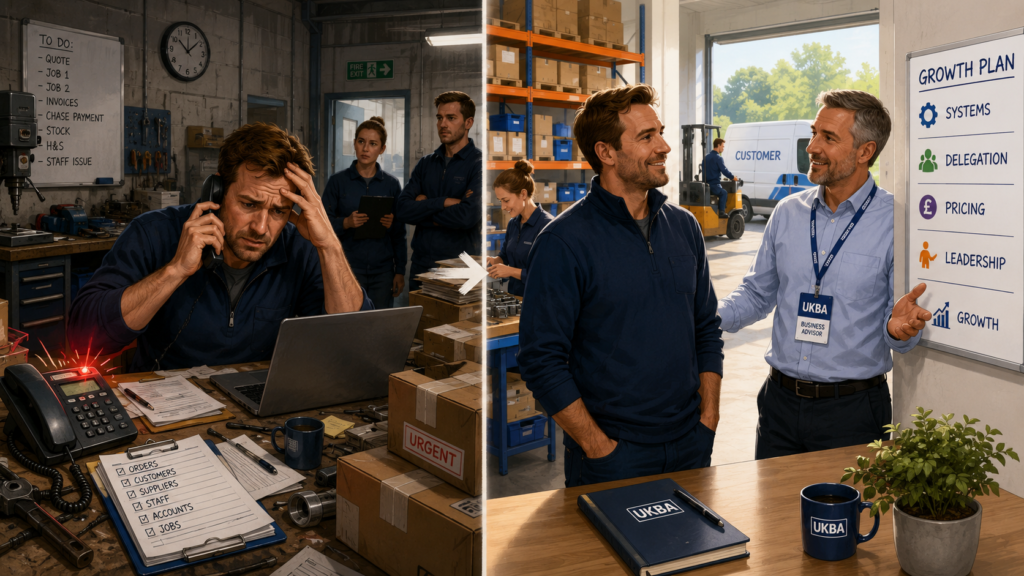
Many SME owners start with a skill. They are good engineers, designers, manufacturers, consultants, builders, accountants, recruiters, technicians or specialists.
Customers trust them because they know what they are doing. They win work because they understand the details. They build the business through effort, reputation and personal commitment.
That is often enough to get started. But it is not always enough to grow. There comes a point when being good at the work is no longer the same as being good at running the business.
The skill that built your business may not scale it
In the early stages, your expertise is a strength.
You can make quick decisions. You know your customer. You can make promises because you know how the work gets done.
But as the business grows, the same strength can become a constraint. More customers bring more complexity. More staff bring more management questions. More sales bring more pressure on systems, cash flow, pricing and delivery.
The owner who was once the source of energy can become the bottleneck.
Everything still comes back to you.
Do you recognise these issues? The team asks you to decide. Customers want your attention. Suppliers need answers. Problems wait until you are available. The business is growing, but it is not becoming easier to run.
Many SMEs rely too heavily on the owner’s memory, judgement and personal intervention.
That may work for a time. But it creates risk.
- If you must approve every important decision, the business slows down.
- If only you understand the margins, pricing becomes inconsistent.
- If only you can manage key customers, the sales process is fragile.
- If you keep stepping in to fix operational problems, managers avoid taking ownership.
This is because the business has not yet built the structure needed for the next stage.
If you are doing too much of the work, holding too much of the knowledge and carrying too many of the decisions, it is both tiring for you and limiting for the business.
Growth needs different skills
Technical skill remains important. But growth needs other skills too. You must learn to step back and look at the business as a whole. That means asking different questions:
- Where does the profit really come from?
- Which customers are worth more attention?
- Which work should we stop doing?
- Are our prices right?
- Do our systems support the business we are becoming?
- Do our managers know what they are responsible for?
- Can the business run properly when I am not there?
These are leadership questions. They are not always comfortable, especially for owners who are used to being hands-on. But they are essential if the business is to grow without becoming more dependent on one person.
More effort is not always the answer
When growth slows, many owners respond by working harder. They chase more sales. They take on more tasks. They stay closer to the detail. They try to push the business forward through energy and determination.
Sometimes that works. Often it only adds pressure. At this stage, the answer may be more focus.
What needs to change?
The shift from technical expert to business leader does not mean the owner must lose touch with the work. It means they need to build a business that does not depend on them for everything.
That usually involves several practical steps.
- Clarify the direction of the business and decide which customers and services matter most.
- Improve pricing and margin control and strengthen management information.
- Define roles and responsibilities and build systems that reduce reliance on individual memory.
- Develop managers who can make decisions and lead people and create regular routines for reviewing progress.
None of this is glamorous. But it is what turns a busy business into a stronger one.
Why outside perspective helps
It is hard to see your own business clearly when you are inside it every day.
Owners often know something is wrong before they can name the issue. They may feel stretched, frustrated or stuck. They may sense the business has reached a ceiling but not know what is causing it.
An outside adviser can help separate symptoms from causes. The problem may look like a sales issue but be a pricing issue. It may look like a people issue but be a structure issue. It may look like a cash flow problem but be a margin problem. It may look like owner overload but be a lack of delegation, management discipline or clear priorities.
A good adviser helps the owner step back, ask better questions and decide what needs to happen next. A UK Business Advisors member can help you review where your business is too dependent on you, identify the barriers to growth and build a practical plan for the next stage.