

Delivering faster problem-solving, fewer errors and better customer feedback
In an unpredictable world, leaders face mounting pressure to deliver better results with fewer resources. without compromising on quality. That’s where Quality 4.0 comes in. This emerging framework from the Chartered Quality Institute shows how to combine human expertise with new technologies to improve products, services and organisational outcomes. Here’s how it works and how to present the principles so they resonate with every stakeholder.
What Is Quality 4.0 and Why It Matters for SMEs
Quality 4.0 blends traditional quality management with digital tools and data-driven thinking. It’s not about replacing people with machines; it’s about combining human judgement with advanced technology to deliver better outcomes. For SMEs, it’s a way to compete with larger players using agility, innovation and customer focus as an advantage.
The Eight Principles That Drive Quality 4.0 Success
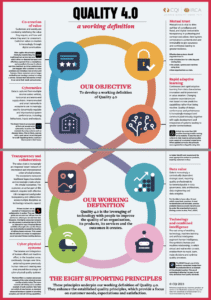
The CQI identifies eight principles that underpin Quality 4.0. They are:
- Mutual trust – Building transparency so that partners, suppliers, and customers believe in the way you use data and deliver services.
- Rapid adaptive learning – Using data to predict customer needs and improve before problems occur.
- Co-creation of value – Designing products and services with your customers, not just for them.
- Cybernetics – Linking systems and processes so that performance is monitored and improved in real time.
- Transparency and collaboration – Sharing information across the value chain to reduce risk and improve outcomes.
- Data value – Treating data as a strategic asset, with governance and analytics at its core.
- Technology and combined intelligence – Combining human insight with AI and automation.
- Cyber-physical systems – Integrating machines and people so they work seamlessly together.
How to Present the Principles for Maximum Impact
To communicate these ideas effectively, adapt the language and examples to your audience. For boards and senior teams, focus on strategic benefits: risk reduction, market differentiation and productivity gains. For operational managers, link the principles to day-to-day improvements such as faster problem-solving, fewer errors and better customer feedback.
Using Charts to Bring Complex Concepts to Life
A visual chart showing all eight principles is an excellent anchor for presentations or reports. Use a simple circular diagram (to reflect their interconnected nature) with each principle as a spoke and practical examples in smaller call-outs. Avoid jargon. Use concise labels and a consistent colour palette (ideally aligned with your corporate brand). For online readers, make it interactive so hovering over each principle reveals the definition and example.
The Role of Advisors in Implementing Quality 4.0
Quality 4.0 can feel complex at first. A skilled advisor can bridge the gap between theory and application, tailoring the framework to your business size, sector and customer needs. UKBA’s quality management experts work alongside you to identify which principles will deliver the fastest returns and ensure they’re embedded in your processes.
Conclusion
The real power of Quality 4.0 lies in its adaptability. It’s not a rigid checklist; it’s a flexible framework that helps businesses navigate complexity and drive results. In a world where standing still means falling behind, the combination of human expertise and digital capability could be your most important competitive advantage.