When assessing whether a business is ready for growth or investment, most leaders look first at people, skills, value proposition and market potential. Documentation may not be as central as those factors, but its contribution to long-term value should not be underestimated.
Documentation Improves Consistency and Efficiency
A company’s people are often its strongest asset, but relying solely on individual expertise creates risk. Processes that deliver value to customers need to be captured clearly so they are not lost when someone leaves or retires.
For many businesses, documentation begins life as part of ISO certification. Yet too often it is treated as a tick-box exercise. In practice, well-written documents help ensure continuity of operations, prevent bad habits from creeping in and support efficient training.
One example comes from a client manufacturing industrial water treatment systems. Standard operating procedures are rarely needed for their most common products, except during onboarding. However, when a rarely ordered legacy product is required, a clear SOP saves hours of searching for old information and reduces errors caused by memory or incomplete records.
Documentation Helps Businesses Learn From Their Own History
Record-keeping can feel old-fashioned, but as teams grow, an authoritative record of past decisions becomes invaluable. It provides clarity on why certain approaches were adopted or abandoned and prevents avoidable repetition of past mistakes.
For product development, technical construction files offer a structured way to capture both evidence of compliance and the lessons learned during testing. They also become valuable training tools when new staff join the team.
Similarly, technical bulletins help explain changes to product designs, ensuring that sales teams can communicate updates clearly to customers and avoid confusion.
Good Customer Documentation Builds Trust and Repeat Business
Investors often ask to see “the manual” when evaluating a product. It is an immediate indicator of professionalism. A clear, well-designed manual supports both end users and customer service teams, and it enhances the reputation of the supplier.
Poor documentation has the opposite effect. A recent example involved shifting from a static PDF manual to a web-based user guide integrated into an online software platform. Early feedback was strong: the guide became part of the product experience rather than an afterthought.
Businesses serious about exporting should also consider the value of high-quality translations. Many industrial products cannot be explained through visuals alone. Consistent, accurate technical terminology is an investment that supports international growth.
A Place for Everything: Managing Documents Properly
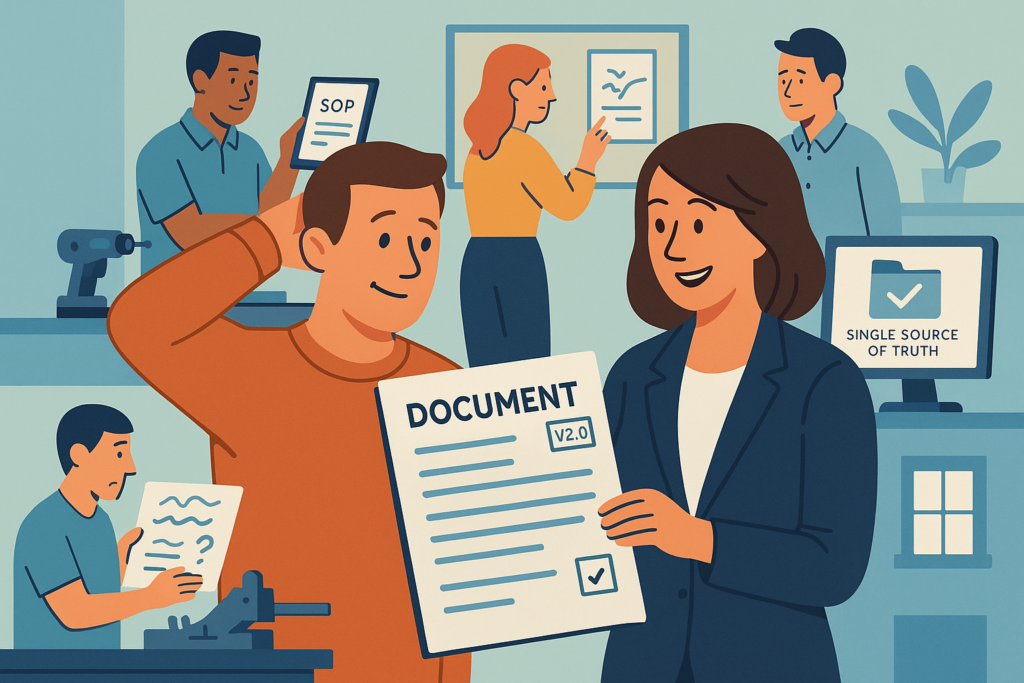
Documentation only adds value if teams can find the right version at the right time. Relying on local PC copies or uncontrolled folders introduces unnecessary risk. A structured document management process with version control creates a single source of truth and reduces the chance of outdated instructions being used in error.
Tyndale offers audits of company documentation to identify gaps, assess suitability, support overseas markets and strengthen storage and access arrangements.
Documentation may not be glamorous, but when it is missing or poorly maintained, the impact is felt immediately. Written and managed properly, documents reduce friction in day-to-day operations, support staff and show investors that a business is built on firm foundations. Think of documentation as the lubricant that keeps your business running smoothly — and make sure the oil is topped up.